
The most popular advice about a mega hair trans in Turkey is also the least useful: maximise the graft count and finish everything in one trip. A large session can be appropriate, but 4,000, 5,000 or more grafts is not a quality score. The sound decision depends on donor reserves, the pattern and stability of hair loss, recipient-site blood supply, and who performs each surgical step.
- Donor capacity comes before graft volume. A single aggressive session can leave visible depletion and no reserve for future loss.
- Staged treatment is not a failure. It can protect donor hair and prioritise the hairline before the crown.
- FUE, FUT and DHI solve different technical problems. DHI does not create extra grafts or bypass biological limits.
- Verify the operating team. Choose Verified Clinics where the named, appropriately licensed and specialist-qualified surgeon's role is documented, rather than relying on marketing language.
- Treat packages as contracts, not holidays. An All-Inclusive label may cover VIP transfer and a 5-star hotel, but only an itemised quote reveals what medical care is included.
What a Mega Hair Transplant Actually Means
A mega hair transplant is usually marketed as a single procedure exceeding roughly 4,000 to 4,500 grafts. That label describes scale and logistics, not whether the plan is biologically sensible.
The question is simpler and harder: can your donor zone support the proposed extraction while preserving a natural appearance and a reserve for later loss? If a clinic starts with “How many grafts do you want?” instead of documenting donor density, the consultation is already pointed in the wrong direction.
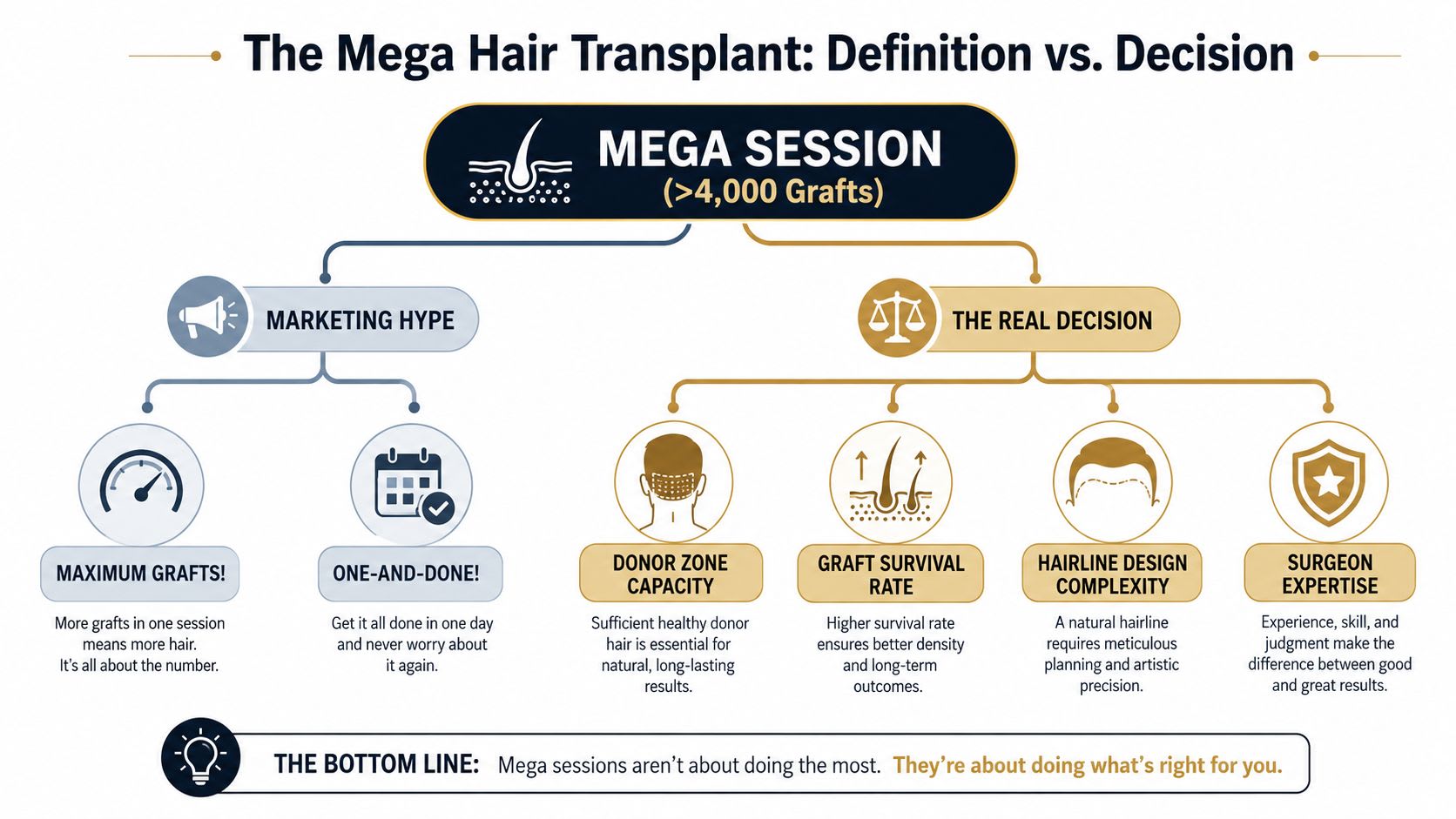
Donor maths beats the headline number
FUE removes individual follicular units from the donor area. Extract too aggressively, and the sides or back can look diffusely thin, particularly with short hair. Those harvested grafts are gone. A patient whose loss continues may then have no reliable reserve for a corrective session.
A staged plan can be more disciplined. The surgeon might restore the frontal frame first, observe how the pattern develops, and consider the crown later. That approach won't create more donor hair, but it can prevent a large initial procedure from spending the entire reserve on areas that may not be equally important over time.
Practical rule: A graft count is only useful alongside a donor assessment, a recipient-area plan and a long-term forecast.
“One-and-done” can conceal delegation
Clinics that promote 6,000-plus grafts in one day may delegate substantial extraction, channel opening or implantation to technicians. Delegation isn't automatically proof of poor care, but the patient must know who performs each step and who remains medically responsible.
Turkey's dedicated hair-transplant framework was introduced in 2023. Secondary legal analysis identifies the regulation as the Saç Ekimi Birimleri Hakkında Yönetmelik, published in the Official Gazette on 6 May 2023, No. 32182, with later amendments, and says it addresses where procedures may occur, who may perform stages and what must be recorded. See the Turkish hair-transplant legal framework analysis for the cited regulatory context.
The country's scale explains why the mega-session model is so visible. Reporting from the Turkish Health Tourism Association placed hair-transplant travel at around 1 million people in 2022, with spending of about $2 billion, roughly half of the reported $4 billion health-tourism turnover that year, as reported by TRT World. That commercial importance makes careful screening more important, not less.
How FUE, FUT and DHI Differ for Large Sessions
The technique should follow the donor zone and the intended coverage, not a brochure's preferred package.
FUE removes units individually
Follicular unit excision, or FUE, uses a small punch to remove individual follicular units. It avoids a linear strip scar and allows the team to select grafts from areas with stronger density, but it can leave multiple small dot scars and may become difficult when extraction is pushed too far in one sitting.
For a large FUE plan, ask who performs the extraction, how the donor area is mapped, and how the team prevents concentrated depletion. A surgeon's supervision matters because punch direction, depth and spacing affect both graft handling and the appearance of the donor zone.
FUT takes a strip
Follicular unit transplantation, or FUT, removes a strip of scalp from the back of the head, which is then dissected into follicular units. It leaves a linear scar, but an experienced team may obtain a substantial number of grafts in one operation without spreading individual extraction across the whole donor zone.
FUT may therefore suit selected patients who need a larger sitting and accept the scar trade-off. It isn't automatically superior. Scalp laxity, hairstyle, previous surgery and the patient's tolerance for a linear scar all need assessment.
DHI changes placement, not supply
Direct hair implantation, or DHI, uses a Choi-style implanter to place grafts directly. The tool can give the operator control over angle, depth and direction during placement, but it doesn't produce new grafts, improve donor supply or replace surgical judgement.
DHI can also take longer because each graft is loaded and implanted through the device. That extra handling may affect the operating plan and price, but it doesn't lift the biological ceiling of the session.
A useful technical overview is available on TurkeyBeautyGuide's hair-transplant treatment page. Read it as background, then ask the surgeon why a specific method fits your scalp.
The implanter is a tool. It isn't a guarantee of density, survival or natural design.
Who Is a Real Candidate for a Mega Session
A genuine mega-session candidate has more than extensive baldness. The patient needs a strong, measurable donor zone, a realistic coverage objective and a pattern that the surgeon can plan over time.
Clinics often discuss donor density above 80 follicular units per cm² as a threshold for a high-volume case, but that figure must be measured rather than assumed from photographs. Hair calibre, follicular-unit composition, scalp contrast and the size of the safe donor zone can change the practical plan.
Stronger and weaker profiles
A patient with dense donor hair and a Norwood III to V pattern may be able to prioritise the frontal region and midscalp in one substantial session. Some Norwood VI patients can also be assessed for larger reconstruction, but the surgeon must calculate whether the available reserve can cover the area without creating an unnatural, thin donor zone.
Diffuse thinning is a warning sign when it reaches the donor region. A Norwood VI or VII pattern with limited reserves is another reason to question a maximum-count plan. Facial-hair transplantation can compete for the same donor resources, so it belongs in the long-term calculation before scalp grafts are committed.
Age matters because active loss can change the map. A 25-year-old who uses 5,000 grafts now might need another 2,000 grafts in seven years, leaving little or nothing for later correction. Those figures are a planning example, not a prediction, and the point is the reserve, not the arithmetic.
| Factor | Good Mega Candidate | Staged or Smaller Session |
|---|---|---|
| Donor zone | Dense, stable and measured across the safe area | Diffuse thinning, miniaturisation or limited reserve |
| Loss pattern | Defined frontal and midscalp loss with a workable long-term plan | Unstable, rapidly changing or unclear pattern |
| Coverage goal | Prioritises visible areas with realistic density | Expects full density across a large bald surface |
| Future needs | Accepts that donor hair must be preserved | May also want crown, beard or revision work |
| Risk profile | No major recipient-site concern identified by the surgeon | Scarring, previous injury or compromised tissue |
Postburn alopecia illustrates why recipient biology matters. In a Turkey-linked retrospective series of 18 male patients, nanofat-assisted FUE produced graft survival of 77.4% to 87.9%, with a mean of 83.2% ± 2.5%, as documented in the published supplementary case series. Scarred tissue may need more conservative density and clearer counselling than an uncomplicated scalp.
The final decision belongs to the surgeon after examination. If the clinic lets the patient choose a graft number before a proper assessment, choose a different consultation.
FUE vs FUT vs DHI at a Glance
For a mega session, the technique name is secondary. The decision rests on donor reserve, the pattern of loss, the planned graft count and the scar risk you accept.
| Decision point | FUE | FUT | DHI |
|---|---|---|---|
| Best fit | Patients prioritising a less visible extraction pattern and possible selective future harvesting | Selected patients who accept a linear scar for a larger single harvest | Patients whose placement plan benefits from the operator's control of direction and depth |
| What sets the limit | Safe donor supply and even distribution, not the clinic's advertised count | Safe donor supply, scalp laxity, previous surgery and scar tolerance | The extraction method still sets the donor limit |
| Main question | Can the team spread extraction without overharvesting? | Is the linear scar acceptable for this patient's long-term plan? | Who extracts, designs, opens channels and places the grafts? |
| Red flag | A promised high count without a mapped donor zone | A strip recommendation that ignores scalp or scar history | A package that presents the device as proof of better results |
Choose FUE when preserving flexibility and avoiding a strip scar matter more than pursuing the largest possible session. A high count still demands measured extraction, consistent graft handling and direct surgeon oversight. The requested total should never dictate the harvest.
Choose FUT only after a surgeon examines scalp laxity, previous procedures and the patient's willingness to accept a linear scar. It can suit a substantial single harvest in selected cases, but it is not a shortcut around donor limits.
Choose DHI for a suitable placement workflow, not for a larger supply of grafts. The implanter cannot strengthen weak grafts, repair poor hairline design or compensate for careless extraction. The operator's training, supervision and role matter more than the device name.
A reliable quote separates extraction from implantation. “DHI package” provides too little information. Ask whether extraction uses FUE, whether a surgeon designs and opens recipient sites, and who places each graft. If the clinic cannot answer those questions clearly, do not book a mega session.
Risks, Recovery and When Results Actually Show
A mega session concentrates more work into one operation. That can reduce travel events, but it can also increase the consequences of poor planning.
The principal risks include overharvesting, reduced survival when graft numbers are pushed beyond the scalp's capacity, shock loss in existing hair, poor angulation and widened scarring after FUT. Poor angulation can create a stiff, artificial “doll-hair” appearance even when the grafts survive.
Recipient-site blood supply deserves particular attention. A Turkish university-published report documented scarring and graft failure in all 18 affected male cases of recipient-site necrosis after FUE, linking the severe pathway to tissue ischaemia rather than simple graft handling. The Biruni University report supports a conservative approach to recipient-site trauma and density.
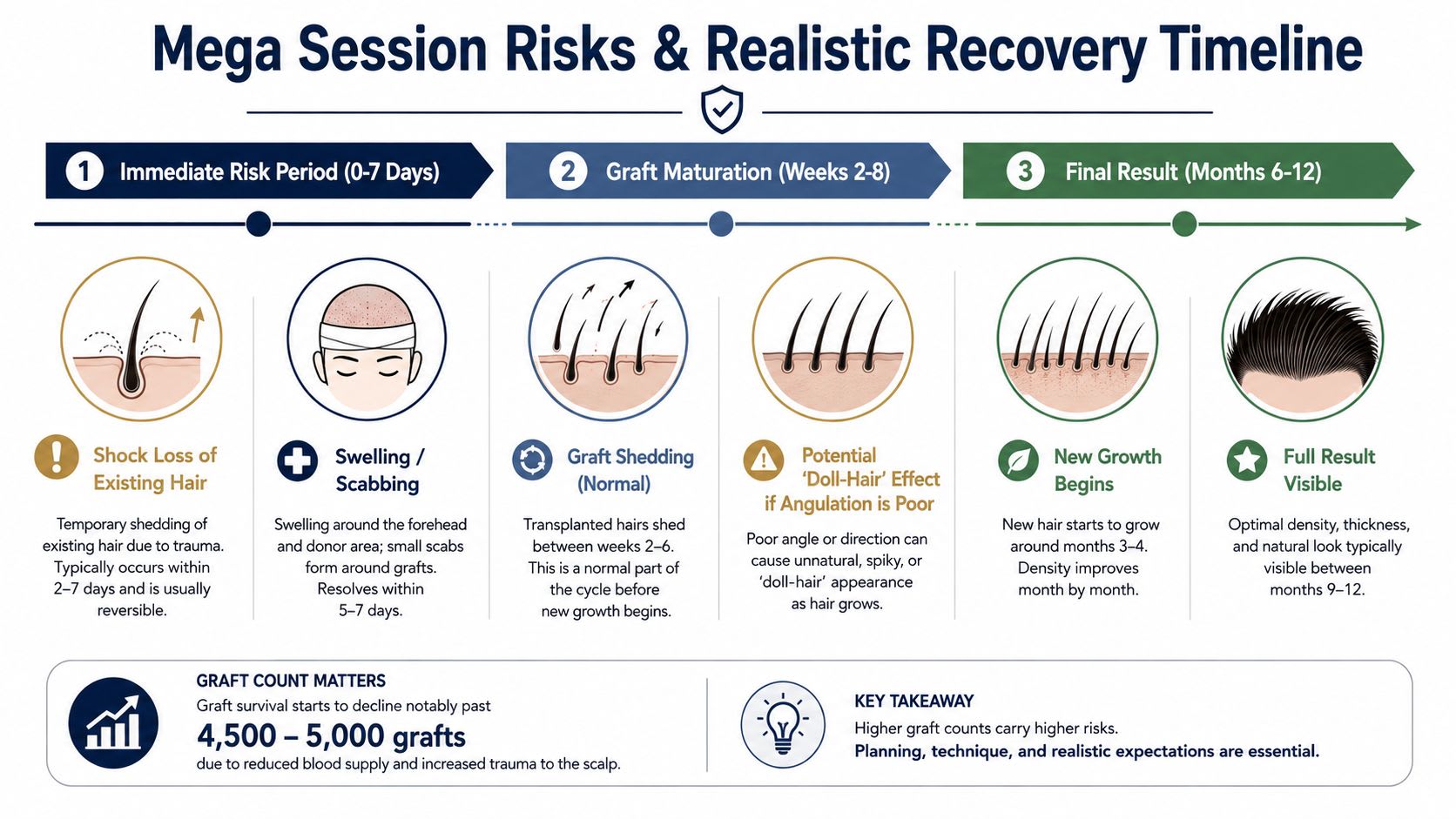
The recovery is a long process
Scabs usually shed by around day 10, but that doesn't mean the transplant is ready for judgement. Existing hair may shed between weeks 3 and 6, while early visible regrowth often begins around month 4. Meaningful density takes longer, and final shaping can continue through 12 to 18 months.
Graft survival starts to decline notably past approximately 4,500 to 5,000 grafts, according to the planning data supplied for this guide. That isn't a universal failure point, but it is a clear reason to challenge any clinic promising a very high count without discussing tissue condition and survival expectations.
Do not judge the result before month 6. Early shedding and uneven growth can look alarming while the follicles are still developing.
Turkey and home recovery
Many patients remain in Turkey for the early review and washing stage. Clinics may provide washes around day 2 or 3, along with instructions and an aftercare kit, but the exact arrangement belongs in writing.
A fit-to-fly letter may be discussed around day 5 to 7 for FUE and day 10 to 14 for FUT, yet a letter isn't a guarantee that travel is medically appropriate for every patient. Swelling, redness and numbness can still be present when you return home. Contact details for urgent questions, a written washing plan and a named follow-up clinician matter more than a generic travel promise.
Protect the scalp from direct sun for about a month and follow the operating team's washing and activity guidance. If pain, spreading redness, fever or unexpected symptoms develop, seek medical assessment rather than assuming every change is normal.
What a Turkey Package Should Cost and Include
Turkey's hair-transplant market operates at substantial scale. Reporting based on Turkish Health Ministry data said Türkiye welcomed about 2 million medical tourists in 2024 and generated close to $3 billion in revenue, while separate reporting recorded 1.39 million medical tourists in 2025, as summarised by NPR's reporting on Turkey's hair-transplant tourism. Hair restoration remains the largest aesthetic category within that wider market.
That scale doesn't make every quote comparable. A lower Turkish price may reflect lower labour costs and government incentives rather than lower clinical quality, but price alone proves neither quality nor safety. Compare the clinical scope, named professionals and exclusions, not just the package total.
Build the quote line by line
An honest proposal should state whether it includes:
- Assessment and planning: Medical history, pre-operative bloodwork, donor evaluation, surgeon consultation and documented hairline design.
- The operation: Technique, estimated graft range, extraction, channel opening, implantation and the name of the responsible surgeon.
- Additional support: PRP or stem-cell support only if specifically described, including whether it is clinically indicated or bundled.
- Travel logistics: Airport or VIP transfer, hotel nights, translator support and transport between the hotel and clinic.
- Aftercare: Medications where legally and clinically appropriate, an aftercare kit, one or two wash sessions, written instructions and a follow-up plan.
Packages often advertise VIP transfer and 5-star hotels. Those benefits may be useful, but they don't compensate for an unnamed surgeon or an unclear operating team. Review options around the main hub through the Istanbul treatment listings, then request the medical quote directly.
Price opacity is the warning
I won't give invented price bands where no current, documented quote dataset is available. Technique, graft range, surgeon involvement, hotel arrangements and aftercare change the total, and an old promotional price isn't a reliable benchmark.
Be cautious with vague “VIP” wording, unlimited graft promises, unnamed clinicians and add-on charges for blood tests or an aftercare kit. Don't accept a headline price below roughly $1.5 per graft without asking who performs the surgery. A low figure can indicate heavy technician involvement, but the price itself isn't proof.
Ask three questions in writing: Who opens the channels? Who places the grafts? Who signs the medical record? If the answer changes between the sales coordinator, consultation and consent form, stop.
Safety Checklist Before You Book
Do this verification before paying a deposit. Sales messages and review videos don't replace a named operating doctor, a documented plan or proof that the facility can lawfully provide the service.
Turkey's regulatory framework requires attention to the unit, the professionals and the records. A 2025 to 2026 summary states that licensed facilities must hold a Hair Transplant Unit Operating License, that only Ministry-certified doctors may make incisions, and that assistants need their own certificates. It also says enforcement runs through 81 provincial health directorates, as described in this summary of Turkish hair-transplant rules.
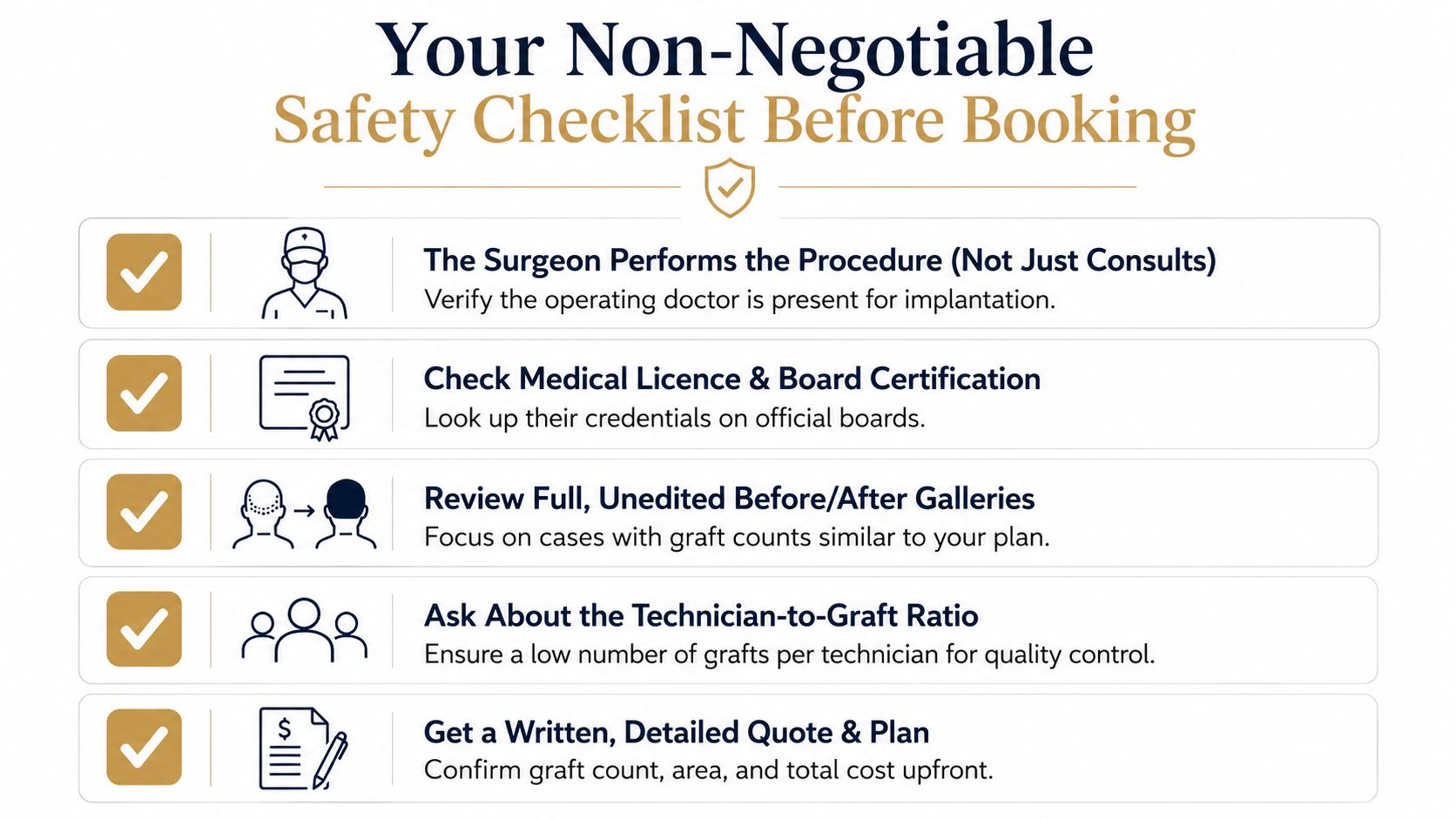
Check the people and the paperwork
The operating doctor's name and licence should appear on the consent documentation. Ask whether the surgeon personally performs extraction, channel opening and implantation, or delegates any of those stages. “Surgeon-led” should describe the actual operating plan, not only a video consultation.
Use this checklist:
- Confirm clinic authorisation: Ask for the Hair Transplant Unit Operating License and verify the facility through the relevant provincial health authority route.
- Verify the clinician: Check the doctor's current licence and specialist qualification. Don't assume that “board certified” in an advert has a meaning you can verify.
- Measure the donor zone: Request pre-operative photographs, donor-density measurements and a map of the proposed extraction area.
- Get the graft range in writing: The plan should identify the target area, estimated graft count, technique and what happens if the safe count is lower.
- Read the complication policy: Ask who handles urgent care, revision discussions, records and communication after you return home.
- Clarify aftercare responsibility: Confirm who performs the washes, when reviews occur and whether instructions are available in your language.
- Review consistent results: Ask for unedited before-and-after images with comparable lighting, angles and graft counts.
JCI status can add useful organisational information, but it isn't a substitute for clinician verification. JCI accredits an organisation, not an individual surgeon. Memorial describes a hair-transplant service within a JCI-certified hospital group, while Acıbadem lists Atasehir Hospital as JCI-accredited with 210 beds and 12 operating rooms, according to the Memorial hospital information. Treat those as institution-level claims, not proof of a particular surgeon's qualification.
Recognise sales red flags
No proper consultation, same-day deposit pressure, all-inclusive pricing without itemisation and no consistent photo gallery should end the conversation. So should a clinic that can't explain who handles complications or refuses to identify the people performing the procedure.
Making Your Final Decision With Confidence
Return to three checkpoints before booking a mega hair trans.
First, require a documented Norwood assessment and donor evaluation. The plan should show which regions receive priority, how the surgeon intends to protect the safe donor zone and why a single large session is preferable to staging.
Second, insist on a surgeon-led consultation. Ask direct questions about extraction, channel opening, implantation, recipient-site risk and future loss. A credible plan may disappoint you by recommending fewer grafts or a second trip. That is often a sign that the clinician is protecting the result rather than selling the largest package.
Third, compare written quotes from at least two Verified Clinics, with the surgeon's name, technique, graft range, hotel and transfer arrangements, aftercare, follow-up and complication pathway clearly stated. Patient references can help, but they don't replace credentials, authorisation or medical judgement.
Turkey's hair-transplant market is significant, and its regulatory framework gives patients specific questions to ask. Use that information to slow down the decision. A staged procedure may be the safer answer when the loss pattern is aggressive, the donor supply is limited or the scalp carries scars.
TurkeyBeautyGuide offers clinic listings and treatment information that can help you compare surgeon details, techniques, package inclusions and aftercare questions before a mega session. Visit TurkeyBeautyGuide to search for verified doctors and check VIP packages, then confirm your individual plan with an appropriately qualified clinician.
Explore More
This article is for informational purposes only and does not replace professional medical advice.