
Trust First: Your top priority must be selecting a Board-Certified Surgeon at a Verified Clinic. This is your best guarantee of safety and quality, often overseen by the Turkish Ministry of Health.
Realistic Timeline: Final results are not immediate. Expect a 12-18 month journey, including an initial shedding phase, before you see the full, mature outcome.
Value Explained: Turkey's affordable prices are due to lower operational costs and government support for medical tourism, not a compromise on quality. Many top clinics are JCI-Accredited.
All-Inclusive Convenience: Most packages bundle the surgery, a 5-star hotel stay, and VIP transfers, creating a stress-free experience for international patients.
Thinking about a hair transplant is a big decision, and those before-and-after photos are usually the first place you look for answers. They're more than just pictures; they tell a story about a surgeon's skill, a clinic’s honesty, and what the patient's entire year-long journey really looked like.
As your consultant at Turkey Beauty Guide, my role is to help you read that story correctly so you understand what’s truly possible and how to achieve it safely.
Reading Between the Lines of Hair Transplant Photos
The single most important decision you'll make is choosing your medical team. It's why we constantly stress the importance of finding Board-Certified Surgeons working out of Verified Clinics.
These aren’t just fancy titles; they're your guarantee that the clinic meets high standards for quality and safety, often enforced by the Turkish Ministry of Health.
What Your Hair Growth Timeline Actually Looks Like
Your hair transplant journey isn't an overnight miracle; it’s a biological process that unfolds in stages. Knowing what to expect and when can make the whole experience much less stressful. Patience is key.
Here’s a realistic breakdown of what you'll see in the mirror:
Right After Surgery (First 1-2 Weeks): Expect your scalp to be red and a bit swollen. You'll see tiny scabs forming around each of the newly placed grafts. This is your body starting the healing process.The "Ugly Duckling" Stage (Weeks 2-8): This part can be alarming if you're not prepared. The small hairs in the transplanted grafts will fall out. It’s completely normal and a necessary step for new, permanent hair to grow.
First Signs of Life (Months 3-4): You’ll start to see the first new hairs pushing through. They'll be fine and sparse at first, but it's a great sign that the procedure is working.
Real Progress (Months 6-9): Now things get exciting. You should see about 60-70% of your final result. The hair is noticeably thicker and longer, giving you a very good idea of the finished look.
The Final Result (Months 12-18): Your hair has now reached its full potential. It will have matured in thickness and texture, blending in perfectly with the rest of your hair.
Think of your hair transplant as a marathon, not a sprint. The real, natural-looking results take a full year to show, which is why any trustworthy clinic will always showcase their outcomes at the 12-month mark.
To help you visualise this journey, here's a quick reference guide.
Quick Guide to Your Hair Growth Timeline
This table gives you a snapshot of what to expect at key milestones after your hair transplant. Use it as a handy reference to set realistic expectations for your recovery and new hair growth.
| Timeframe | What You Will See | How You Will Feel |
|---|---|---|
| 1–2 Weeks | Redness, swelling, and small scabs on the scalp. | Mild discomfort or tightness, which is easily managed. |
| 2–8 Weeks | The initial transplanted hairs will shed. | A little impatient, but this is a normal part of the process. |
| 3–4 Months | Fine, new hairs begin to sprout. | Excited to see the first signs of real growth. |
| 6–9 Months | 60-70% of the hair has grown in, looking thicker. | More confident as your new hairline takes shape. |
| 12–18 Months | Full, mature hair growth with final density and texture. | Thrilled with the final, natural-looking result. |
Remember, everyone's healing process is slightly different, but this timeline provides a solid framework for what you can anticipate.
Why Is Turkey Such a Popular Choice?
Many people ask how hair transplants in Turkey can be so affordable without sacrificing quality. It comes down to simple economics—lower labor costs and government incentives reduce operational expenses for clinics.
This has nothing to do with cutting corners on care. In fact, many of the best facilities are JCI-Accredited hospitals, the international gold standard for patient safety.
To make the process even smoother, most Verified Clinics put together All-Inclusive Packages. These typically cover your surgery, a stay in a 5-star hotel, and all your airport and clinic transfers in a VIP vehicle.
Your path to restoring your hair should start with confidence. We encourage you to Search for verified doctors on our platform and Check VIP Packages to begin your research the right way.
The First Two Weeks: Your Healing Journey Begins
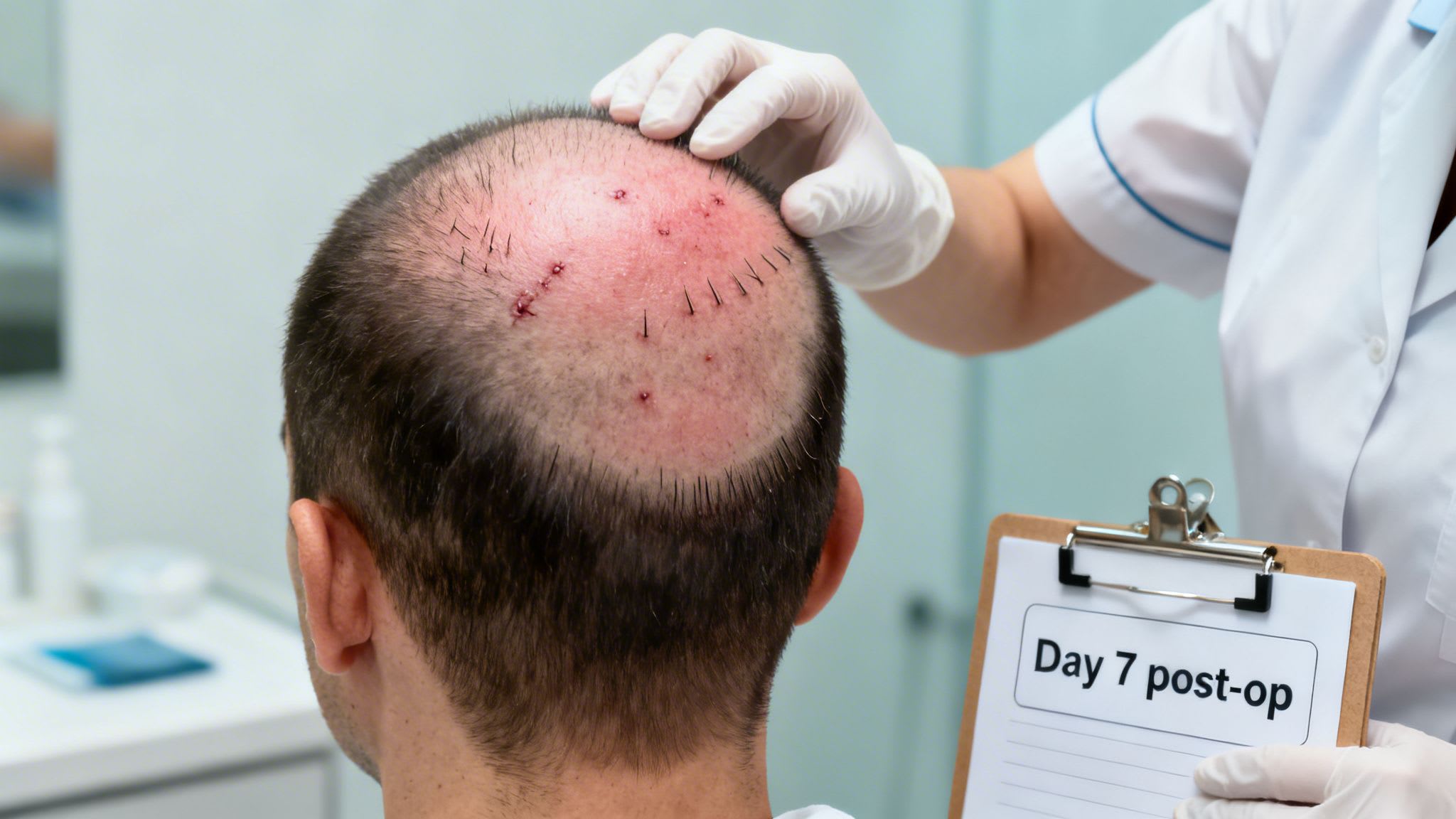
The first couple of weeks after your hair transplant are the most critical phase for your final outcome. The newly placed grafts are delicate and need the right conditions to take root.
This initial period isn't about looking for new growth—that comes much later. It’s all about creating the perfect healing environment. Following your clinic's post-op instructions to the letter is the blueprint for success.
What to Expect Day-by-Day
Straight after the procedure, you'll see evidence of the work on both the recipient and donor areas. This is completely normal and just your body kicking off its natural healing process.
Here’s a look at what’s typical:
Redness and Swelling: Expect your scalp and maybe your forehead to be a bit red and swollen for a few days. This usually peaks around day three before it starts to calm down.
Mild Discomfort: You might feel a bit of tightness in the donor area. This is easily handled with the pain relief your clinic will give you.
Scabbing: Tiny scabs will form around every implanted graft. These protect the follicles and will fall off on their own, usually within 7 to 10 days.
I can't stress this enough: do not pick at the scabs. If you do, you risk pulling the grafts right out, and they won't grow back. A little patience now will pay off for years.
The All-Important First Hair Wash
One of the first major milestones in your recovery is the first post-op hair wash. This is almost always done for you at the clinic, typically a day or two after your surgery.
The medical team has a very specific technique to gently clean your scalp without disturbing the grafts. They'll show you exactly how to do it yourself so you can continue the routine back at your hotel. This washing process is vital for preventing infection and helping scabs fall away naturally.
This is a key reason we recommend choosing a JCI-Accredited Hospital. Their hygiene and patient care protocols are incredibly strict, ensuring this step is done perfectly.
Your job is simple: follow their instructions precisely. Proper aftercare gives your investment the best possible start and sets the stage for the growth you're waiting for.
Your journey has just started, but the foundation for a fantastic hair transplant surgery before and after result is built in these first few critical days. We advise patients to Search for verified doctors and Check VIP Packages to ensure the entire process is handled by true professionals.
Mapping Your Hair Growth Milestones
One of the hardest parts of a hair transplant journey is being patient. Everyone wants instant results, but the "after" photo that really counts isn't taken for at least a year.
A common myth is that you'll walk out of the clinic with a full head of hair. The day of the procedure is just planting the seeds. The real growth unfolds over the next 12 to 18 months.
The Initial Shedding Phase (1 to 3 Months)
Don't panic when you see hair falling out shortly after your procedure. This is completely normal and expected—it's called “shock loss.”
The newly transplanted hairs shed to make way for new, stronger hairs to grow. Your scalp is healing, and the follicles are establishing a new blood supply during this quiet phase.
The First Sprouts (3 to 4 Months)
Right around the three-month mark, you'll start to see the first signs of life. These first hairs are usually very fine and thin, a bit like baby hairs.
It might not look like much, but this is a huge milestone. It’s proof that the transplanted follicles have taken hold and are officially back in business.
Think of it like planting a new lawn. You don't get a thick carpet of grass overnight. First, you see tiny green shoots poking through the soil. That's this stage.
This new growth marks the end of the dormant period. From here on out, the hair texture and thickness will only improve over the coming months.
Noticeable Growth and Density (6 to 9 Months)
This is when the transformation really picks up speed. Between months six and nine, those fine, early hairs begin to mature, becoming thicker and longer.
By the six-month point, most people see about 60-70% of their final result. Your new hairline will be clearly defined, and you’ll notice the density improving week by week.
This is often when you can start styling your hair again. A Board-Certified Surgeon's skill is key here, as they ensure the hair is placed with the right angle and density to look completely natural.
Full Maturity and Final Results (12 to 18 Months)
The final look you've been waiting for arrives between 12 and 18 months post-op. By now, the transplanted hairs have reached their full potential.
So, why the long wait? Every hair follicle works on its own schedule. It takes a full year or more for every single one to cycle through and for the hair shaft to thicken completely.
This is exactly why any trustworthy, Verified Clinic will only show "after" photos taken at the one-year mark or later. That’s the only point you can truly judge the success of their work.
To get started on the right foot, Search for verified doctors and Check VIP Packages to make sure you’re in expert hands from the very beginning.
How FUE and DHI Techniques Shape Your Final Look
When you're scrolling through impressive hair transplant surgery before and after photos, you’re really seeing the work of a specific surgical technique. The two leading methods are Follicular Unit Extraction (FUE) and Direct Hair Implantation (DHI).
While both produce fantastic, natural-looking hair, they work differently. A Board-Certified Surgeon will recommend the best path for you based on your unique hair loss pattern and goals.
FUE: The Gold Standard for Harvesting
Follicular Unit Extraction, or FUE, is how hair grafts are taken from the donor area. The surgeon uses a micro-punch tool to carefully extract individual hair follicles one by one.
So, what makes FUE so popular?
Minimal Scarring: FUE leaves tiny, dot-like scars that are practically invisible. This means you can wear your hair short without a second thought.
Faster Donor Area Healing: With no large incision, the back of your head recovers much faster and with less discomfort.
Versatility: Grafts can even be sourced from other parts of the body in rare cases where the scalp donor area is thin.
DHI: Precision in Implantation
Think of Direct Hair Implantation (DHI) as a refined version of FUE with a special focus on the placement of the hair. Grafts are loaded into a sophisticated tool known as a Choi Implanter Pen.
This pen is the real game-changer. It allows the surgeon to implant each follicle directly into the scalp, giving them incredible control over the depth, angle, and direction of every single hair.
This control is crucial for creating a soft, natural-looking hairline and achieving the full, thick look everyone wants.
Many top clinics in Turkey use a hybrid approach: FUE for gentle extraction and DHI for precise implantation. This gives you the best of both worlds.
The hair growth journey isn't instantaneous. It's a gradual process, but an exciting one to watch. The timeline below gives you a clear picture of what to expect.
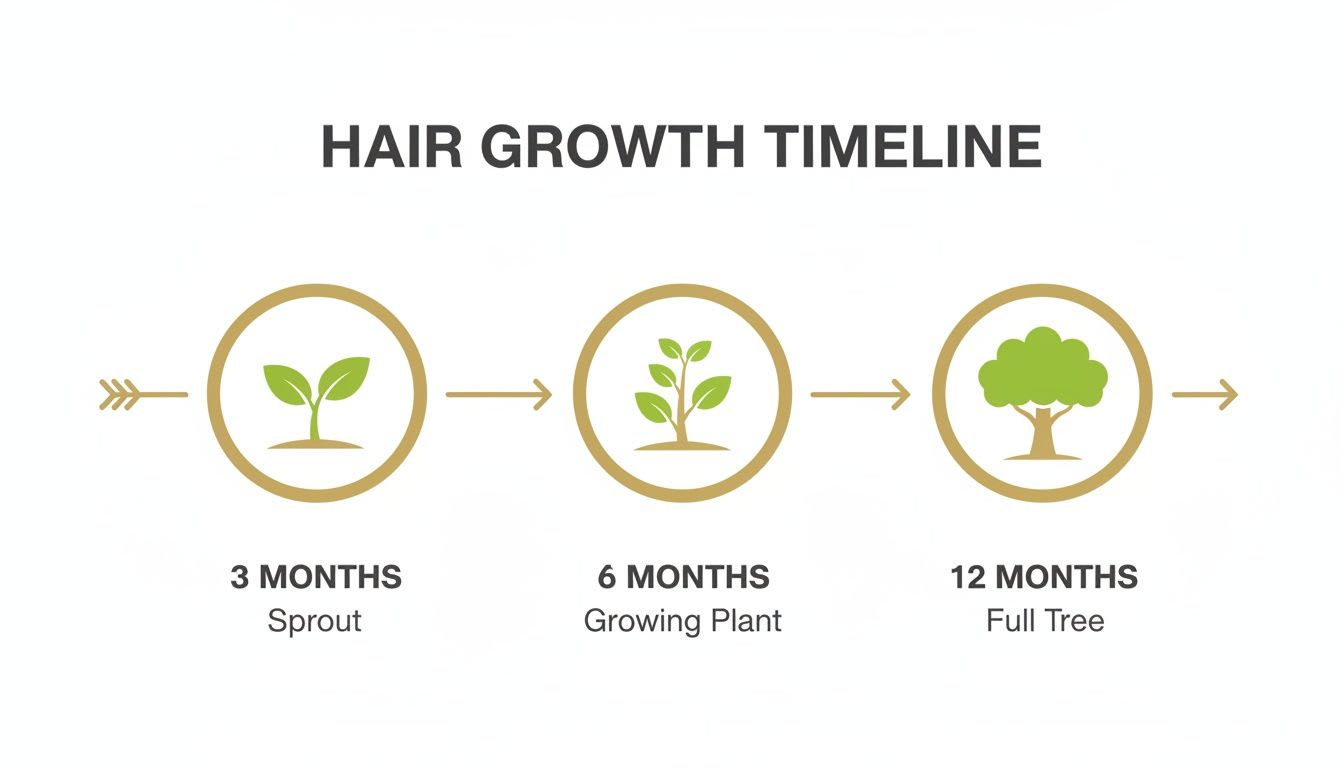
As you can see, the most dramatic changes really start to show between the 6 and 12-month marks. That's when you'll begin to see the final result you’ve been waiting for.
Your main task is to find a Verified Clinic led by a surgeon with a portfolio of natural-looking results. You can learn more at this top-tier DHI and FUE Sapphire hair transplant clinic in Turkey.
A great place to start your research is to Search for verified doctors and Check VIP Packages right here on Turkey Beauty Guide.
How to Analyse Before and After Photos Like an Expert
When exploring medical tourism, learning to look at a clinic's results with a critical eye is your single greatest asset. Those hair transplant surgery before and after photos are a clinic's CV.
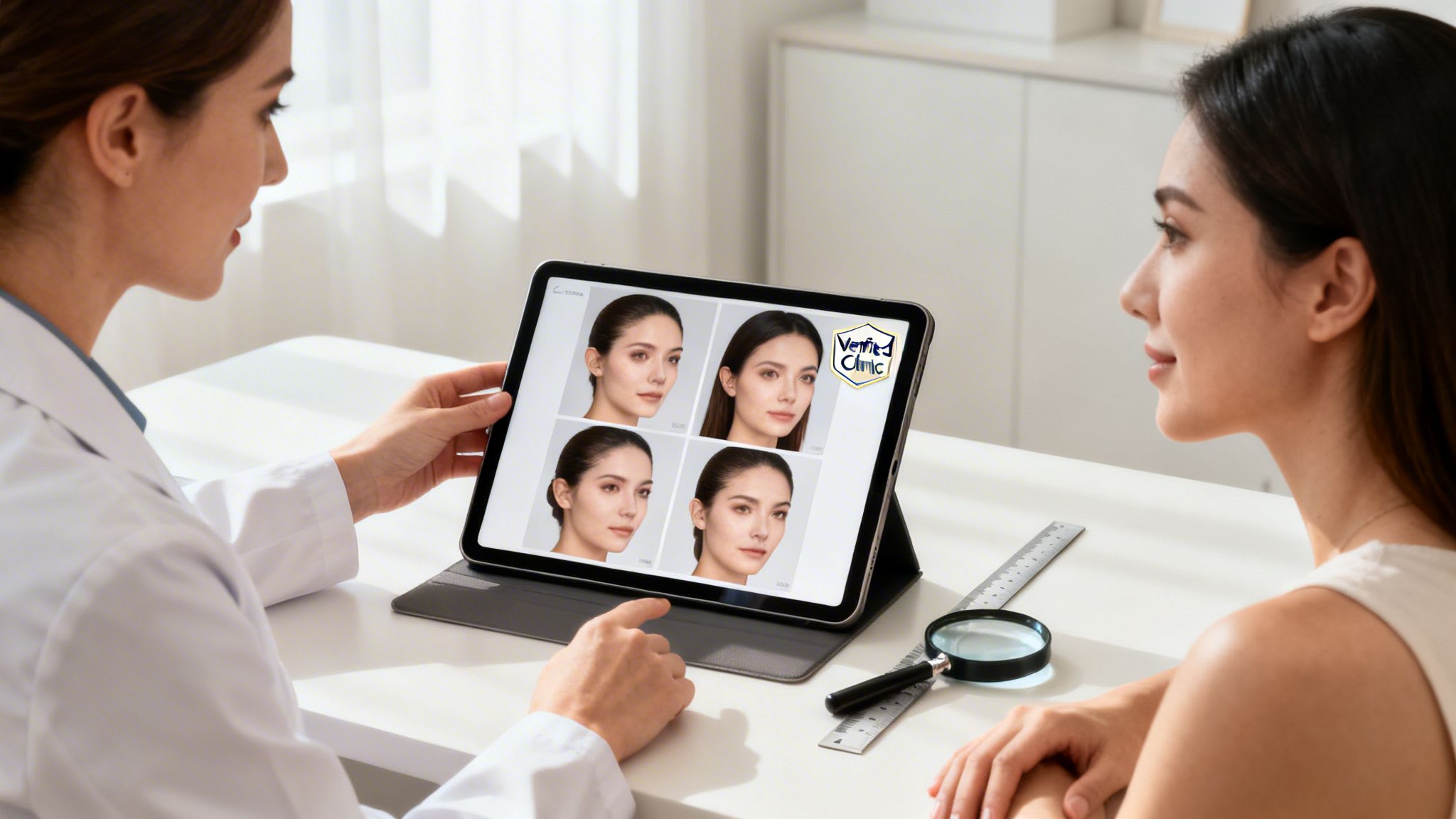
A trustworthy clinic has nothing to hide. Their photo gallery should be an honest, clear portfolio of a Board-Certified Surgeon's work, not a masterclass in photo editing.
Spotting the Red Flags of Photo Manipulation
Some clinics use subtle tricks to make their results seem better than they are. These manipulations can set you up with false expectations.
Here are the biggest warning signs to watch out for:
Inconsistent Lighting: A "before" picture taken under harsh, direct light that makes thin spots look worse, followed by an "after" shot in soft, flattering light.
Different Hair Styling: The "before" photo shows hair wet or slicked back to expose the scalp. The "after" photo shows the hair dry and fluffed up to create the illusion of volume.
Use of Concealers: Some clinics use hair fibre concealers in their "after" shots. Look for an unnatural, matte texture that doesn't reflect light like real hair.
An honest clinic will present their work under consistent, bright, clinical lighting from multiple angles (front, top, sides, and back). If the setting and lighting change dramatically, that's a red flag.
The Hallmarks of an Authentic Result
A truly skilled surgeon’s work speaks for itself. Verified Clinics take pride in their authentic results and are happy to show them off transparently.
Here’s what you should be actively looking for:
- High-Resolution Images: The photos must be clear enough to zoom in. You should be able to see individual hairs and the scalp.
- Multiple Angles and Timestamps: A proper case study needs to show the patient's head from all sides and clearly state it's at the 12-month mark or later.
- Video Testimonials: Photos can be doctored, but it's much harder to fake a video. A clinic that shares video interviews with past patients is showing confidence in its work.
It’s crucial to understand that affordability in Turkey comes from economic factors, not from cutting corners on quality. You can learn more about how hair transplant costs in Turkey offer genuine value without compromising on quality.
Putting in this due diligence now is the first step toward a result you'll be proud of for years. When you are ready, you can Search for verified doctors and Check VIP Packages right here on our platform.
Why Turkey Offers Such Incredible Value and Quality
One of the first questions we get is, "Why is a hair transplant so much cheaper in Turkey?" The value you find in Turkey comes down to economics, not a compromise on medical excellence.
The main reason is the country's economic landscape. Operational costs and professional salaries are significantly lower than in the UK, USA, or Western Europe. This allows a world-class clinic to pass those savings directly on to you.
A Global Hub for Hair Restoration
Turkey has become the undisputed global centre for hair restoration, built on decades of innovation and strong government backing for medical tourism.
The growth has been staggering. The sheer volume of procedures gives surgeons a level of hands-on experience that’s nearly impossible to find anywhere else. For a deeper dive, you can explore the impressive scale of hair transplant statistics in Turkey.
Many of the best clinics operate within JCI-Accredited Hospitals, meaning they meet the highest international standards for patient safety. Choosing a Verified Clinic means you're tapping into this vast reservoir of specialised expertise.
The All-Inclusive Package Advantage
To make the entire process smooth and stress-free, most top clinics offer All-Inclusive Packages. This bundles everything you need into one clear price, with no hidden costs.
A typical All-Inclusive package usually covers:
The complete hair transplant procedure with a Board-Certified Surgeon.
Your stay in a comfortable 5-star hotel during recovery.
VIP transfers to and from the airport, hotel, and clinic.
A personal translator and all necessary post-op care supplies.
The point of this bundled approach is to give you total peace of mind. It lets you focus on your procedure and recovery, knowing all logistics are handled by experts.
For instance, a globally recognised clinic like the Dr. Serkan Aygın Clinic has perfected this seamless patient experience over many years.
Getting your hair transplant in Turkey means you don’t have to sacrifice quality for price. You truly get the best of both worlds.
Your first step should always be to do your homework. We recommend you Search for verified doctors and Check VIP Packages right here on our platform to find a provider that meets your standards.
Common Questions About Hair Transplant Surgery
As you dive into the world of hair transplant surgery before and after photos, a lot of questions will naturally pop up. I wanted to tackle the most common concerns head-on.
My goal is to give you straightforward, honest answers to help you feel more confident. A well-informed decision is always the best decision.
How Much Pain Is Involved in the Procedure
This is one of the first things people want to know. The surgery itself is done under local anaesthesia, so your scalp will be completely numb.
Once the anaesthesia wears off, mild discomfort or tightness is normal, especially in the donor area. This is typically very manageable with the pain relief medication your clinic will provide and fades within a few days.
Will My Hair Transplant Look Natural
A natural result is everything, and achieving it comes down to the skill and artistry of your medical team. It's far more than just relocating hair follicles.
A few key elements make a hair transplant undetectable:
Hairline Design: A master surgeon creates a soft, slightly irregular hairline that perfectly suits your age and facial structure, avoiding ruler-straight lines.
Graft Angle and Direction: Every single graft has to be placed at a specific angle and direction to mimic the way your natural hair grows.
Density Distribution: The surgeon strategically places the grafts to build up density in a way that looks full and healthy, never artificial.
This is exactly why choosing a Board-Certified Surgeon is non-negotiable. Their experience is the single biggest factor in getting a result you’ll love.
A great hair transplant should be your secret. The best work is completely invisible, blending seamlessly with your existing hair.
What Are the Main Risks of Hair Transplant Surgery
While modern hair transplantation is a very safe procedure, it’s still surgery. We believe in being upfront about potential risks, however small they may be in the right hands.
Potential issues can include infection, excessive swelling, or subpar graft survival. Your best defence against these is choosing a Verified Clinic that operates within a JCI-Accredited Hospital.
These facilities are held to the highest international standards for hygiene and safety, which dramatically reduces any risks. For a deeper dive, learn more about how to find the right clinic for your needs in our guide.
How Do I Find a Reputable Clinic in Turkey
This is the most critical part of your entire journey. The quality of your result and your safety hinge on choosing your clinic wisely.
Begin by looking for clinics that show transparent galleries of before-and-after photos and video testimonials. Verify the surgeon's credentials and the clinic's accreditations. Before committing, you should have a detailed virtual consultation with a medical professional.
At Turkey Beauty Guide, we are dedicated to connecting you with facilities that meet the highest standards of safety and quality. Your journey to restored confidence starts with making an informed choice.
Search for verified doctors or Check VIP Packages to begin your research with trusted professionals.
Explore More
This article is for informational purposes only and does not replace professional medical advice.