
You've found an x ray centre in Turkey with a convenient appointment and an attractive quote. Before paying a deposit, check something more important than speed or price: is the facility legally authorised, who supervises the imaging, and what records will you take home? Ministry authorisation, TÜSKA accreditation and JCI accreditation are separate signals, not interchangeable badges.
Key Takeaways
- Ministry of Health authorisation is the legal starting point. Ask for the facility's operating permit and confirm that its licence covers the imaging you need.
- TÜSKA and JCI are additional quality signals, not substitutes for legal authorisation. JCI accreditation applies to an organisation, usually a hospital, not automatically to an individual radiology unit.
- Private x ray centres are usually more convenient for international patients, but the fee can exclude reports, translations, contrast, additional views or follow-up.
- Ask for a named radiologist, equipment details, radiation-dose information where relevant, and DICOM images in a usable format.
- Choose Verified Clinics and appropriately licensed, specialist-qualified clinicians. Don't rely on a “Board Certified” or accreditation badge without checking the issuing body.
Why International Patients Look at X Ray Centres in Turkey
A UK resident may need a dental CBCT before implant planning. A patient from the Gulf may schedule mammography during a family visit, while an EU retiree may arrange spine or knee films alongside an orthopaedic consultation. For each patient, the decision rests on three practical questions: who is authorised to provide the service, what quality oversight exists, and what the quoted price includes.
Turkey attracts international patients because private healthcare facilities commonly serve overseas visitors, and some centres provide digital equipment with English-speaking administrative or radiology staff. Istanbul is often the first city considered because it has a broad concentration of private hospitals and outpatient facilities. This Istanbul medical services guide offers city-level context, but facility-level verification still comes first.
Start with legal authorisation. A centre providing x rays, dental radiography or another radiology service should operate within the relevant Turkish regulatory framework. Ask to see evidence of the Ministry of Health permit and confirm that it covers the service you intend to receive.
Quality oversight requires a separate check. Ministry authorisation, TÜSKA accreditation and JCI accreditation are distinct signals, with different purposes and scopes. A Ministry permit establishes the right to operate. TÜSKA or JCI may indicate organisational quality review, but accreditation alone does not guarantee that every examination is appropriate for you. Check the referral, examination requested and clinician's rationale.
Cost comes next. A private appointment may reduce waiting and paperwork, yet the initial quote may cover only the scan. Confirm whether the fee includes the radiologist's report, English translation, contrast if required, additional views, image storage, a USB or cloud link, and communication with your doctor at home.
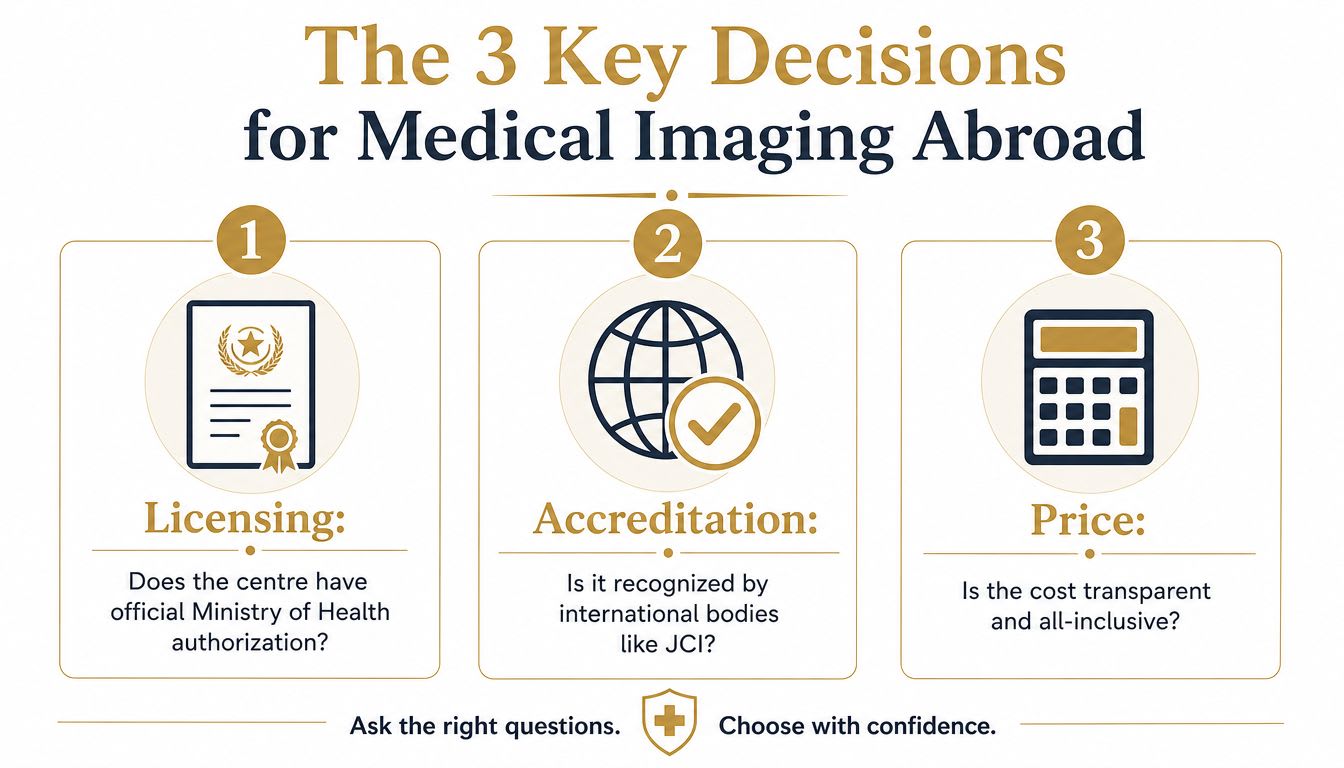
Use this as an advisory guide, not a recommendation for a particular provider. Verify the centre before paying a deposit, then confirm that your home clinician can understand and use the report and images.
Imaging Services You Can Expect at a Turkish X Ray Centre
A referral for jaw pain, a pre-operative check, or a suspected joint injury should determine the examination you book. An x ray centre may offer a single radiography service or several radiology modalities, so choose according to the clinical question rather than the length of its equipment list.
Dental CBCT produces a three-dimensional view of the jaw. It supports implant planning, assessment of impacted teeth, and selected bone or sinus examinations. The referral should identify the anatomical area and purpose, allowing the operator to select an appropriate field of view and limit unnecessary scanning.
Panoramic dental radiography provides a broad, two-dimensional view of both jaws for initial assessment, orthodontic planning, or general review, though a focused intraoral image or CBCT may better answer a specific clinical question.
A chest x ray gives a basic view of the lungs, heart silhouette, and other chest structures. Clinicians may request it for pre-operative assessment or an immigration-related medical pathway. Screening and diagnostic examinations follow different aims, and the referral can affect the number of views and the radiologist's interpretation.
Orthopaedic films can cover the spine, knee, hand, shoulder, or another joint. Weight-bearing images, comparison views, and specialised positioning may affect the result. Give the centre the referring clinician's exact request, including the side and body area when relevant.
Mammography uses x ray imaging to screen for or investigate breast findings. Some facilities also provide tomosynthesis, which creates multiple angled views when the radiologist considers it appropriate.
| Modality | Typical Clinical Use | Referral Required |
|---|---|---|
| Dental CBCT | Implant planning, selected jaw and bone assessment | Usually recommended |
| Panoramic dental radiography | Broad dental and jaw overview | Often requested by a dentist |
| Chest x ray | Pre-operative, respiratory or administrative assessment | Commonly requested |
| Orthopaedic radiography | Spine, knee, hand and other bone or joint imaging | Strongly recommended |
| Mammography and tomosynthesis | Screening or investigation of breast findings | Screening or clinician referral may apply |
| Ultrasound | Soft tissues, abdomen, thyroid and selected vascular assessments | Depends on the examination |
| DEXA | Bone-density assessment | Usually clinician-directed |
| Fluoroscopy | Real-time x ray guidance for selected procedures | Requires a defined clinical indication |
Some centres provide ultrasound, DEXA bone densitometry and basic fluoroscopy alongside radiography. MRI and nuclear medicine generally operate through separate departments or partner facilities, so confirm where those examinations will take place before booking.
The available service menu depends on the centre's licence class, equipment, and specialist supervision. Ask for the precise examination name, whether a radiologist will report it, and which images and report you will receive. A facility saying that it “does radiology” is not enough to confirm that it can perform the examination your clinician ordered.
How Turkey Regulates X Ray Centres
Turkey's regulatory framework treats radiology as a controlled healthcare service, not a retail scan. The Ministry of Health rules cover facilities providing diagnostic and therapeutic radiology, nuclear medicine and oral-dental-jaw radiology, with requirements concerning the building, radiation protection, patients and workers. The framework also defines a radiology centre as a unit providing imaging under the responsibility of a radiology specialist or a specialist authorised to practise independently. The Turkish radiology services regulation is the primary document to consult.
Ministry authorisation is the legal baseline
A centre needs formal permission before it can operate. The regulatory process includes a Ministry pre-permit before an application for Nuclear Regulatory Authority authorisation, and existing centres have had to bring their operations into line with amended requirements and renew permits within the applicable transition period. The amendment to the radiology services regulation sets out that authorisation structure.
For dental units, the relevant legislation makes a dental radiology unit mandatory in centres and requires x ray devices to hold a licence from the Nuclear Regulatory Authority. Where a dental unit treats patients from outside its own centre, the rules also require radiology specialist involvement.
TÜSKA and JCI answer different questions
TÜSKA, the Türkiye Health Services Quality and Accreditation Institute, is Turkey's national healthcare quality and accreditation body. Its accreditation pathway concerns quality systems beyond the minimum permission to operate. It shouldn't be confused with the Ministry licence, and you should check the scope carefully. A facility may have quality accreditation for a hospital or service that doesn't cover the specific radiology unit you plan to use.
JCI, or Joint Commission International, is an organisation-level international accreditation. It may apply to a hospital, but it doesn't certify an individual radiologist and doesn't automatically mean that every outpatient centre connected with the hospital carries the same status. Confirm any claim in the JCI accredited organisations directory, rather than trusting a logo on a homepage.
Practical rule: Treat Ministry authorisation as the legal floor. Treat TÜSKA and JCI as separate quality checks, not replacements for the operating permit.
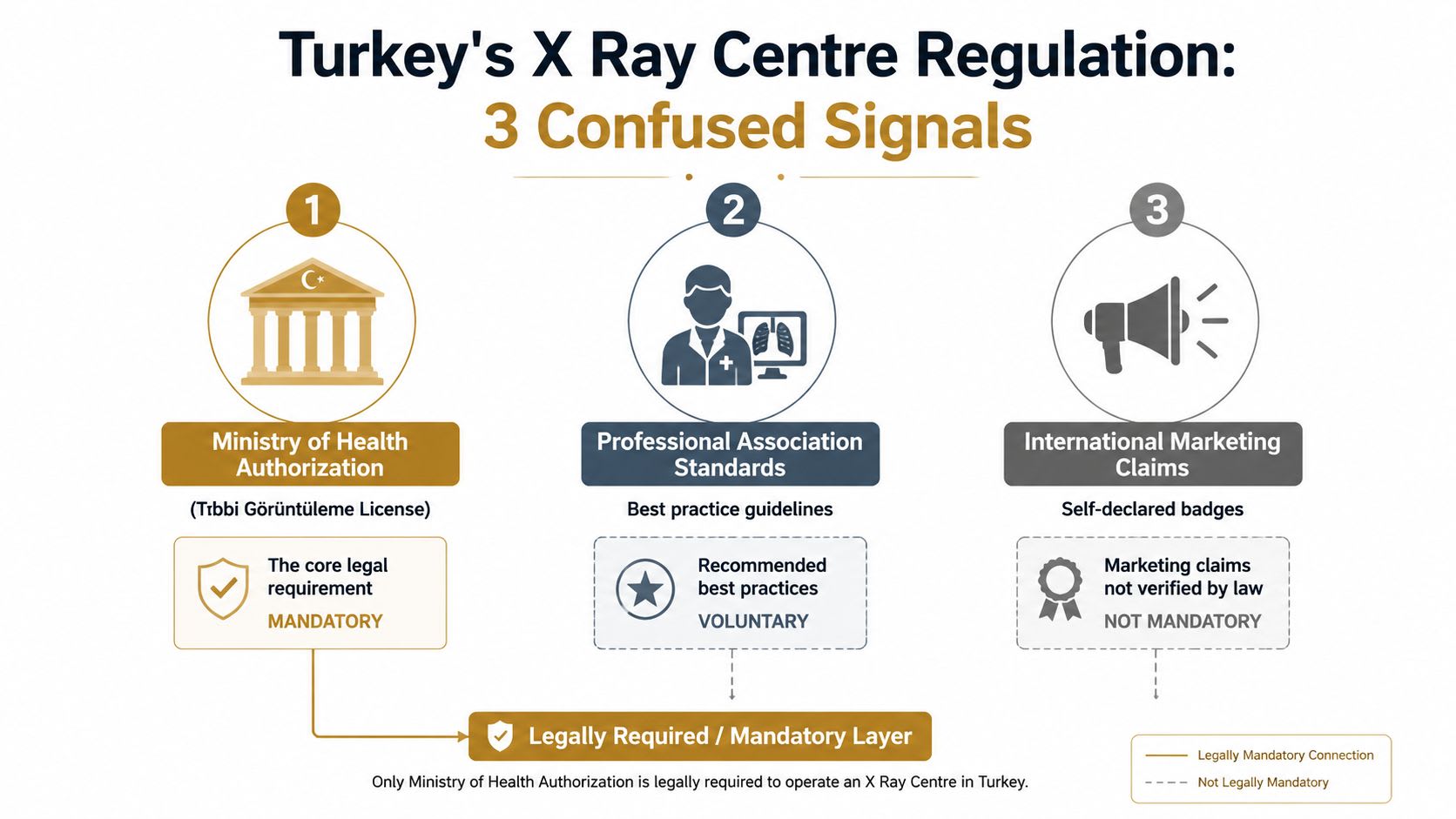
Your verification sequence should be simple. Identify the exact legal facility name, check its Ministry status and permit, confirm the modality is covered, then investigate TÜSKA or JCI only if the centre claims either status. Finally, ask who is responsible for your report.
Radiation Dose and Safety for Medical Travellers
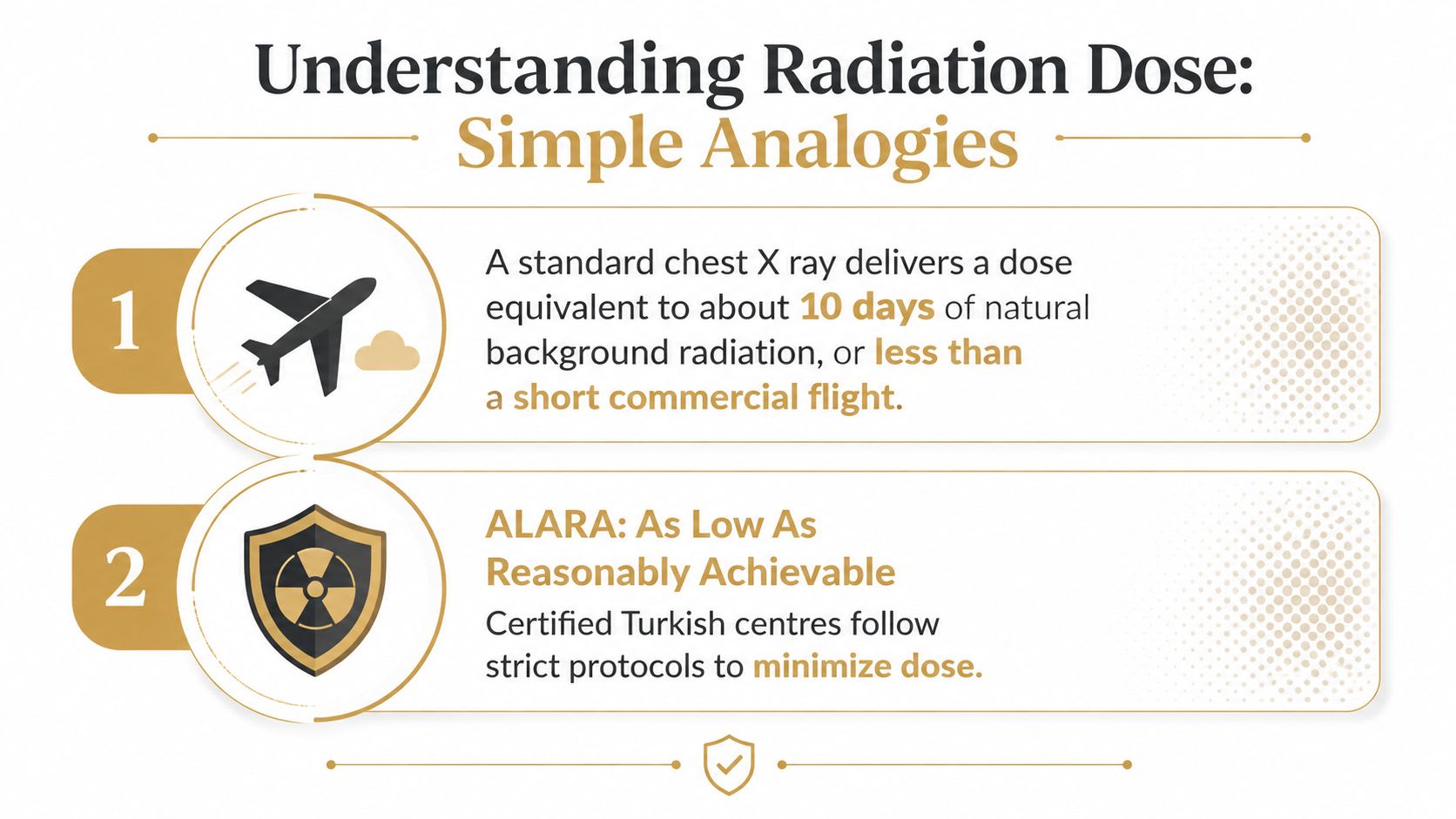
An x ray uses ionising radiation, but the dose depends heavily on the examination, equipment, positioning and protocol. A standard chest x ray is often explained through everyday comparisons, including natural background exposure and a short commercial flight. The mandatory dose infographic presents those analogies, but they shouldn't be used to decide whether you need an examination.
The correct principle is ALARA, meaning “as low as reasonably achievable”. The aim is to obtain an image that answers the clinical question while avoiding unnecessary exposure. Turkish centres operating under the Ministry framework should have radiation-protection procedures for patients and workers, but you should still ask what examination has been ordered and whether previous images could answer the question.
Safety checks worth expecting
A competent service should confirm your identity, examination and pregnancy possibility where relevant. The radiographer should position you carefully and limit the beam to the area being examined. Equipment should be maintained and calibrated, and the radiologist should review the study rather than leaving interpretation to a machine or an unnamed technician.
For some examinations, shielding may be considered as part of local protocol. The important protection is correct justification, positioning, collimation, equipment performance and trained staff. A lead apron isn't a substitute for avoiding an unnecessary exposure.
Discuss non-urgent imaging with a clinician if you're pregnant, particularly in early pregnancy; if the patient is a child and ultrasound or MRI could answer the question; or if you've recently undergone several higher-dose studies. Don't cancel medically necessary imaging independently. Ask the referring clinician or radiologist to weigh the benefit against the exposure.
Contrast is different from the x ray exposure itself. If contrast is planned, tell the centre about previous reactions, allergies and relevant medical history, and ask how screening and emergency response are handled. For broader patient-safety reading, use this medical research resource, then discuss your own situation with a qualified clinician.
Request a record of the examination and, where available, the dose information. Keeping your images and reports together helps your home clinician avoid repeating tests and gives you a usable history for future care.
Public System Versus Private X Ray Centres in Turkey
The public and private pathways solve different problems. Public hospitals generally involve more formal referral and administrative steps, while private x ray centres often organise appointments around an international patient's schedule.
Public facilities can be appropriate when the case is complex, oncological or likely to need subspecialist review. University hospitals may offer academic radiologists and a wider clinical network. The trade-off is that appointment access, paperwork, language support and report delivery may be less convenient for a visitor.
Private centres usually focus on access and logistics. They may offer faster appointments, English-language administrative support, digital image delivery and teleradiology arrangements. Those conveniences come with an out-of-pocket fee, and the quality of the handoff still depends on the named radiologist, reporting process and documentation.
| Factor | Public Hospital | Private X Ray Centre |
|---|---|---|
| Payment | May involve social security coverage or public tariffs, subject to eligibility | Usually self-funded, unless an insurer agrees to cover it |
| Referral | A Turkish physician requisition may be required | Self-request may be accepted for simple studies, but clinical referral is safer |
| Waiting time | Can be longer, particularly for high-demand imaging | Often more appointment flexibility |
| Reporting | May follow hospital systems and local language conventions | May offer English reports, but confirm before booking |
| Complex cases | University and specialist networks can be valuable | May refer complex examinations to a hospital or partner service |
| Records | Hospital-based record system may be available | Ask for DICOM, report, translation and clinician contact separately |
Some public systems have limited equipment availability, and the OECD reports 30 CT, MRI and PET scanners per million people in Türkiye, compared with an OECD average of 51 in its country comparison. The OECD Türkiye health profile provides the source and the comparison.
International insurers may require pre-authorisation whichever pathway you choose. Don't assume that paying privately removes the need for a referral, especially for mammography, contrast examinations or imaging intended to guide treatment.
Private is often faster and easier for travellers. Public care may be less expensive for eligible patients, but it can require more paperwork and patience.
How to Verify an X Ray Centre Before You Book
A centre can respond quickly on WhatsApp and display modern equipment online while still leaving its legal status unclear. Before paying a deposit, gather the following information in writing from the centre, then verify it independently.
Confirm the legal facility
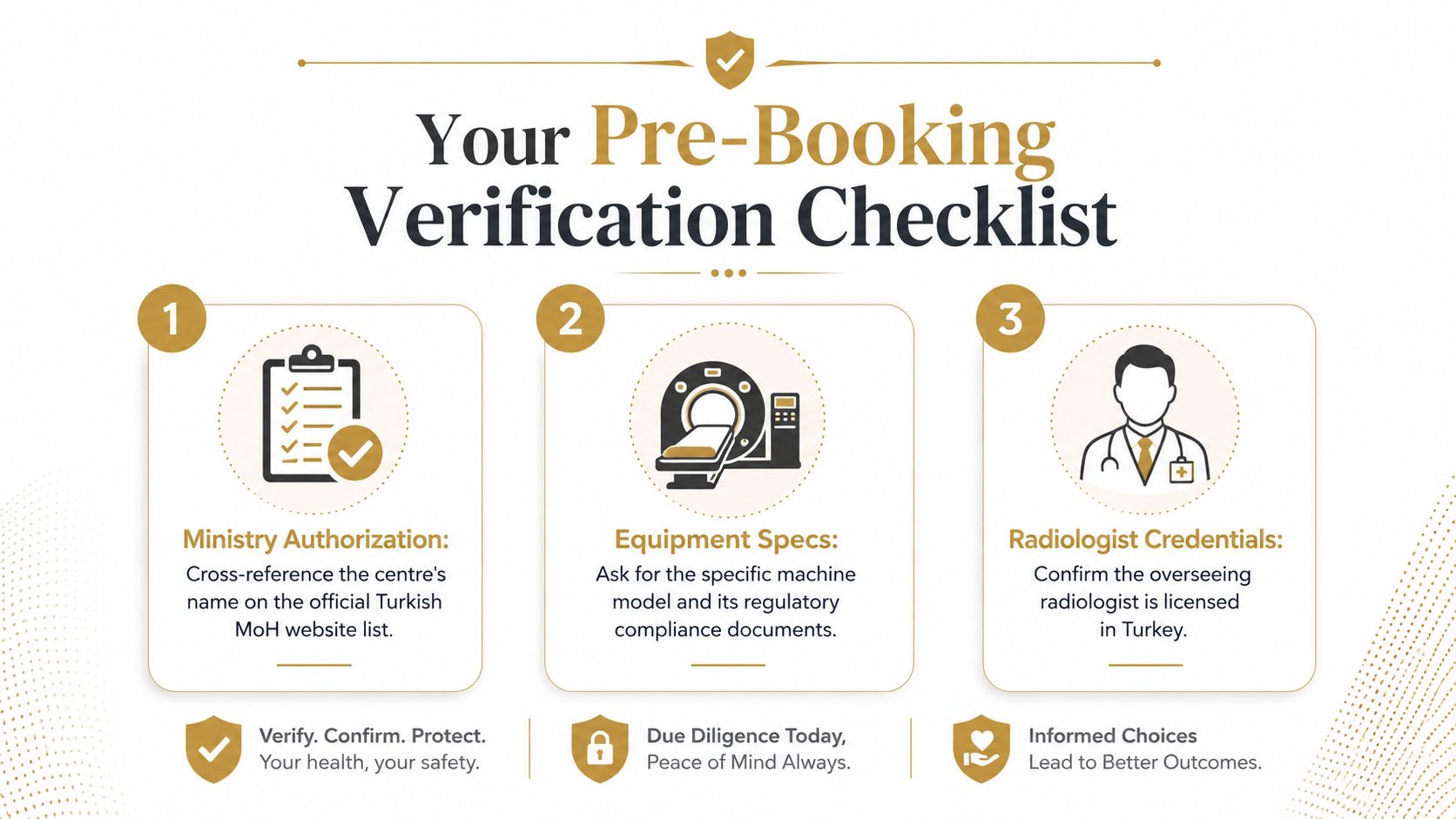
Request the centre's full legal name, address, operating permit number and the imaging modalities covered by its authorisation. Compare these details with the relevant Ministry of Health facility information. The service may operate under a hospital or company name different from the brand shown in its marketing, so confirm which legal entity will perform and report your examination.
Ask who holds clinical responsibility for the service and who will sign the report. The Ministry framework distinguishes a radiology centre from other imaging services and assigns responsibility to an appropriately qualified radiology specialist.
Treat accreditation as a separate check
If the centre claims TÜSKA accreditation, ask for its current certificate and scope. Section 3 explains how this framework differs from Ministry authorisation. Here, confirm only that the certificate covers diagnostic radiology or the service you plan to receive.
For a JCI claim, search the organisation in the official JCI accreditation directory and check its current scope and dates. JCI status is separate from Ministry authorisation and TÜSKA accreditation. It also does not establish an individual clinician's credentials or automatically cover a standalone centre operated by a hospital.
Get the practical details
Ask these questions before you commit:
- Radiologist details: What is the supervising radiologist's name, Turkish licence or registration information, specialist status and reporting responsibility?
- Report language: Will the report be issued in English, and will a qualified medical translator prepare any translation?
- Equipment information: What are the manufacturer, model, examination capability, maintenance record and most recent service date?
- Image delivery: Can you receive DICOM files through a secure cloud link, USB or another format your home clinic can open?
- Price inclusions: Does the quoted price include the scan, radiologist report, translation, contrast, additional views, images, storage and follow-up communication?
A refusal to name the radiologist, share licence details or identify the equipment is a reason to pause. You may compare clinic profiles, but a listing does not prove current authorisation. Verify the facility and its documents yourself.
The Patient Journey From Referral to Follow-Up
A well-run imaging visit begins before you arrive. Send the referral letter, relevant symptoms, prior reports and previous images in advance, with permission from your home clinician. The centre should confirm which examination it will perform and whether any preparation is needed.
At arrival, staff should verify your identity, examination and consent. Tell them about pregnancy possibility, previous contrast reactions, relevant allergies and recent imaging. If the clinical indication is incomplete, ask the centre to contact the referring clinician rather than proceeding with an examination chosen only from a price list.
After the scan, ask how the images will be interpreted. You need the radiologist's written report, the image files and a way for your home clinician to ask a clinical question. A CD alone may not be compatible with your home hospital's PACS system, so request DICOM files and confirm the delivery method before leaving.
Translation deserves attention. A report issued only in Turkish may be difficult for your UK, EU, US or Swiss clinician to use, and automated translation can mishandle clinical terminology. Confirm whether the English version is a professional translation or an explanatory summary, and keep the original report with it.
Flying after an imaging appointment depends on the examination, any contrast used and your clinical circumstances. Ask the radiology team or referring clinician for individual travel instructions, including hydration and what to do if you feel unwell. Don't treat a routine scan appointment as a substitute for medical clearance to fly.
Keep a personal record containing the referral, report, images, dose information where available, contrast details and the centre's contact details. The strongest marker of a properly organised service isn't only a clear image. It's a clean handoff to the clinician responsible for what happens next.
Key Things to Confirm Before You Book an X Ray in Turkey
A centre can offer a low quote and still leave important questions unanswered. Use this check before paying a deposit. If staff cannot provide clear answers, choose another provider.
- Ministry authorisation: Request the centre's legal name, address and authorisation number. Cross-check these details through the Ministry of Health and confirm that the permission covers the imaging you need.
- TÜSKA scope: Treat TÜSKA as a separate accreditation signal, not a substitute for Ministry permission. See the regulatory explanation in section 3, and review the healthcare quality and accreditation institute for the current position.
- JCI status: JCI is also separate from Ministry authorisation and TÜSKA accreditation. See section 3 for verification guidance. A badge on a website is not proof, and accreditation applies to the organisation within its stated scope.
- Named reporting clinician: Ask who will sign the report, what specialist qualification they hold and whether the report will be issued in English.
- Equipment and files: Request the machine model, recent service information, DICOM delivery method and a sample report format before payment.
- Written quote: Obtain the currency and a written list of what the examination, report, translation, contrast, additional views, image storage and follow-up include.
- Radiation information: For a child, pregnancy concern or repeated imaging, ask for the protocol explanation and dose documentation.
- Responsibility for findings: Confirm who is responsible for the report and how urgent findings are escalated.
- Home-clinician handoff: Confirm how images and reports will reach your referring radiologist or doctor, and whether clinician-to-clinician contact is available.
Your minimum standard is legal authorisation, a named qualified reporting clinician and a complete records handoff. TÜSKA and JCI may provide useful context, but neither confirms that the examination is appropriate for you.
For international health tourism, check whether the provider appears on the Ministry's authorised provider list. This is stronger evidence than a marketing statement. Turkey's international health-tourism regulation creates further accreditation and certification requirements for authorised facilities by the end of 2026, as described in TÜSKA's regulatory notice.
TurkeyBeautyGuide helps patients compare clinic profiles, clinician qualifications, treatment details, written quotes and aftercare arrangements before travelling for care. Visit TurkeyBeautyGuide to search for appropriately qualified doctors, review available clinic information and check VIP packages without treating convenience or price as proof of quality.
This article is for informational purposes only and does not replace professional medical advice.